
3D Tours, Floor plans, and Drone: The Three Tools That Pre-Sell A Home
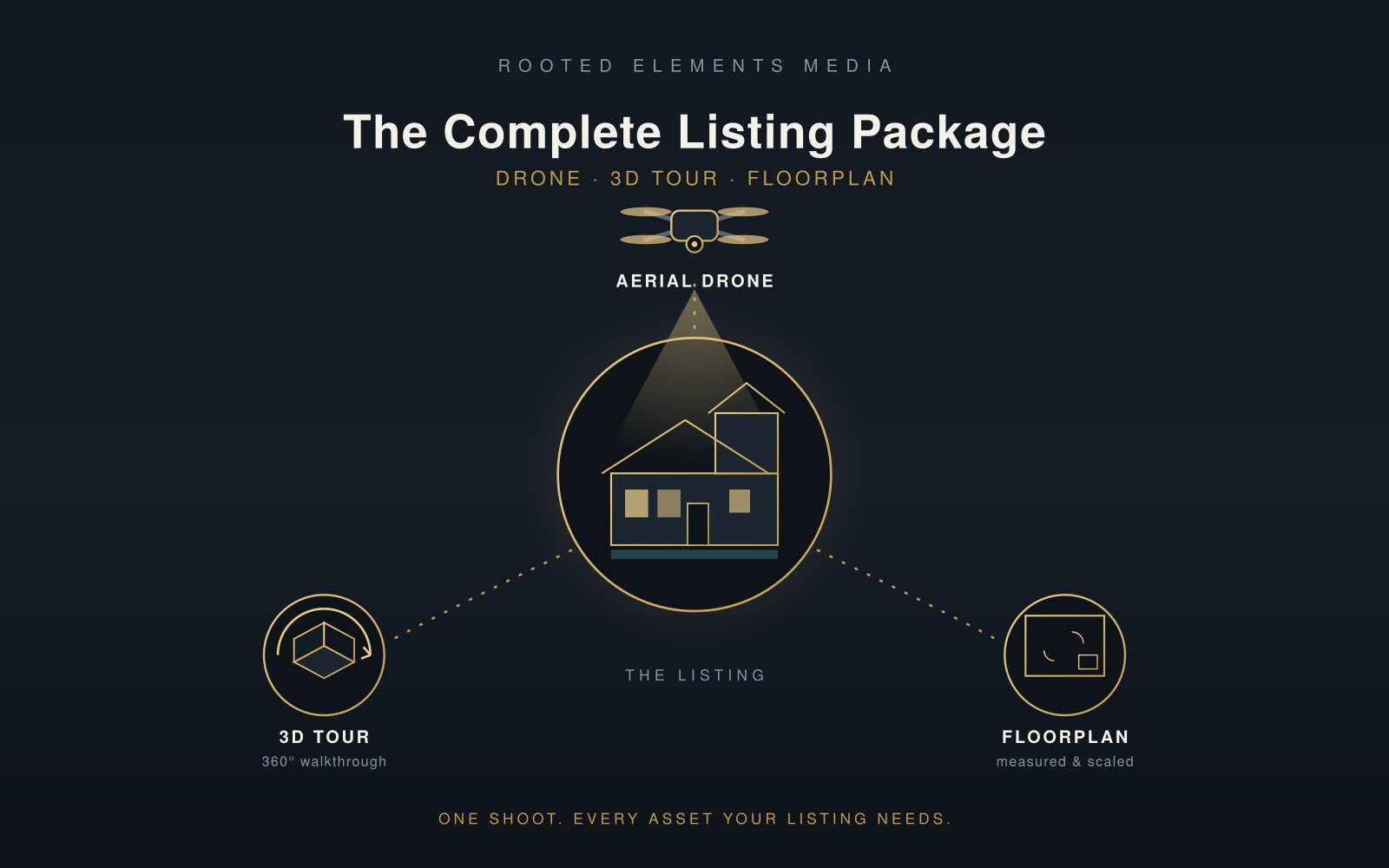
Photos sell the first three seconds. They stop the scroll, create interest, and get a buyer to slow down. But a buyer who's interested still has questions your photos can't answer: How does the house actually flow? Is the primary really that far from the kids' rooms? What's the lot backing up to? Those questions are what kill momentum between "I like it" and "let's see it." Three tools answer them before the buyer ever picks up the phone — a 3D tour, a floor plan, and drone. Used together, they turn a good photo set into a listing that pre-qualifies its own showings.
Here's what each one is actually doing for you as the listing agent, and why they hit harder as a package than any one of them alone.
The 3D tour: it lets the buyer walk the home at 11pm
A Matterport-style 3D tour lets a buyer move through the house on their own — click room to room, look up at ceilings, spin around, get a real sense of scale and connection. It's the closest thing to a private showing that costs you nothing to run and never closes.
What that does for you is filter. Buyers who tour a home in 3D and still request a showing are more serious, because they've already accepted the layout and the feel. The lookie-loos self-select out. That's fewer wasted showings and a shorter path to real offers.
It also opens the door to buyers who can't physically walk in — and in Las Vegas that's a real slice of the market. Relocation buyers from California, second-home buyers, out-of-state investors: they shop online first and often write before they ever land. A real 3D tour is what lets them get comfortable enough to move. Without one, you're asking an out-of-town buyer to make a seven-figure decision off a photo grid, and most won't.
The floor plan: it answers the question photos can't
Photos show you rooms. They don't show you how the rooms relate. A buyer can love every individual space and still can't tell whether the office is off the entry or buried in the back, whether the primary is split from the secondary bedrooms, or how the kitchen opens to the yard. That uncertainty is friction, and friction slows deals.
A clean floor plan removes it in one glance. It shows flow, room relationships, and how square footage is actually used — the stuff that determines whether a home fits a buyer's life. For families it answers the bedroom-separation question. For entertainers it shows how the living, kitchen, and outdoor spaces connect. For anyone, it turns a stack of pretty rooms into a home they can picture living in.
The best part for you: if you're already shooting a 3D tour, the floor plan is often a next-day deliverable pulled from the same scan. You're adding one of the most-requested pieces of listing info for almost no extra lift.
Drone: it sells everything outside the walls
Interior media sells the house. Drone sells the setting — and in this market the setting is half the price. Lot size, proximity to a golf course, mountain lines, Strip views, gated privacy, distance from neighbors, the shape of the backyard and where the pool sits. Buyers pay real money for those things, and none of them read from a ground-level photo.
An aerial does three jobs at once. It proves location as an asset — one frame shows the golf frontage or the view corridor that a listing description just claims. It shows the full property, which matters enormously on larger lots and luxury estates where the land is part of the value. And it creates the single most shareable image in the set: a hero aerial that stops the scroll on social and carries the listing across Instagram and YouTube.
For luxury Las Vegas listings this isn't a nice-to-have. When you're selling a home for the community, the view, and the lifestyle around it, refusing to show those from the air is leaving the best part of the pitch on the ground.
Why they win together
Each tool closes a different gap. Photos create interest. The 3D tour lets the buyer accept the layout and feel. The floor plan resolves the flow questions. Drone proves the setting and the location. Run them together and you've answered nearly every question a buyer has before they book — which means the showings you do get are with people who've already sold themselves on the fundamentals and just need to confirm.
That's the real benefit to the listing agent. This package doesn't just make the home look good. It shortens time on market by filtering serious buyers up front, it wins over out-of-town and relocation buyers who'd otherwise pass, and it makes your listing presentation stronger before you've even signed — because a seller who sees this package understands exactly why they're hiring you instead of the agent showing up with a phone.
